 Opera Houses in Italy
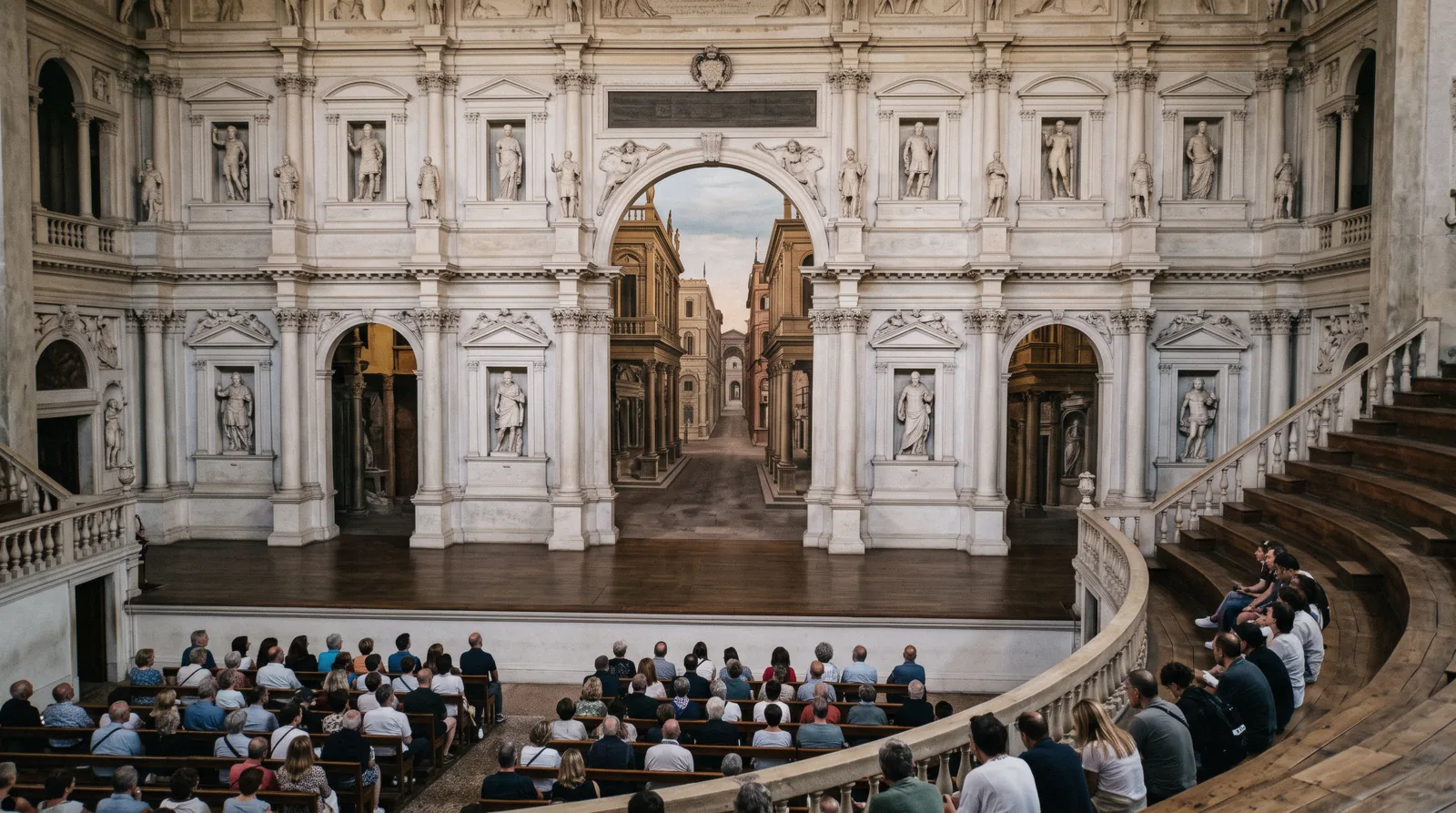
The Teatro Olimpico Vicenza is the last design by Andrea Palladio and the oldest surviving indoor theatre with its stage set still in place. Its wooden streets of Thebes, built in 1585, stand behind the scaenae frons today. This guide covers tickets, hours and the bookable tours, plus how it fits with the rest of the opera houses in Italy worth a detour. For the full list, see our guide to the opera houses in Italy.
Quick answer Teatro Olimpico in brief
The Teatro Olimpico in Vicenza was designed by Andrea Palladio, completed by Vincenzo Scamozzi and opened on 3 March 1585 with Sophocles' Oedipus Rex. It holds the oldest surviving stage set in the world: seven wooden perspective streets of Thebes behind the stage wall. Entry costs $13.38 (€12), and the theatre is closed on Mondays.
Key takeaways
- Book the Palladian Classic full-day experience to combine the theatre, a Palladian palace and an e-bike ride to Villa La Rotonda.
- Short on time? The guided Olympic Theater and Palladian monuments walk covers the theatre and the Basilica Palladiana in 1.5 hours.
- Pair the visit with opera nearby: the Arena di Verona festival runs in summer, less than an hour away by road (our estimate).
Key facts
Opening hours
| 1 September to 30 June, Tuesday to Sunday | 09:00–17:00 |
|---|---|
| 1 July to 31 August, Tuesday to Sunday | 10:00–18:00 |
Closed Mondays, 25 December and 1 January
Admission
- Adult
- $13.38 (€12)
- Reduced
- $18.95 (€17) Vicenza Card Silver, four sites
Planning it
- Time needed
- Our estimate: 45 minutes to an hour for the theatre alone, a full morning with a tour
- Book ahead
- Optional — walk-up usually fine
- Address
- Piazza Matteotti 11, 36100 Vicenza
Which Teatro Olimpico ticket or tour should you book?
The table compares the bookable tours of Vicenza that include the Teatro Olimpico, with what each one includes, how long it lasts and who it suits. If a tour does not include theatre entry, you pay the standard $13.38 (€12) ticket on top.
Do you want just the theatre, the whole of Palladio's Vicenza, or the city plus a villa in the hills?
| Option | Price | Length | Includes | Book |
|---|---|---|---|---|
| Vicenza: Guided Olympic Theater & Palladian Monuments TourBudget travellers who want a guide for the theatre and the city centre | $38 per person | 1.5 hours | Guide, Teatro Olimpico entry by option | Check Availability |
| Vicenza and the Olympic TheatreCouples and families who want a private guide in English, Spanish or Italian | $173 per person | 2 hours | Private guide, ends inside the Teatro Olimpico | Check Availability |
| Palladian Classic - Vicenza 1st ExperienceVisitors with a full day who also want Villa La Rotonda and a Palladian palace | $111.59 per person | Full day | Teatro Olimpico and Palazzo Valmarana Braga entry, e-bike to La Rotonda | Check Availability |
The first option may not include the theatre ticket, so check the option you select, since entry costs $13.38 (€12) separately. Figures current in Q4 2026.
All bookable Vicenza tours
These are the tours currently listed for Vicenza and the Teatro Olimpico. All three meet in or near the centre of town.
 from $38
Guided
Vicenza: Guided Olympic Theater & Palladian Monuments Tour
A guided walk to Palladio's Teatro Olimpico and the Basilica Palladiana in Vicenza.
Check Availability from $173
Private
Vicenza and the Olympic Theatre
A private two-hour tour of Vicenza ending inside the Teatro Olimpico.
Check Availability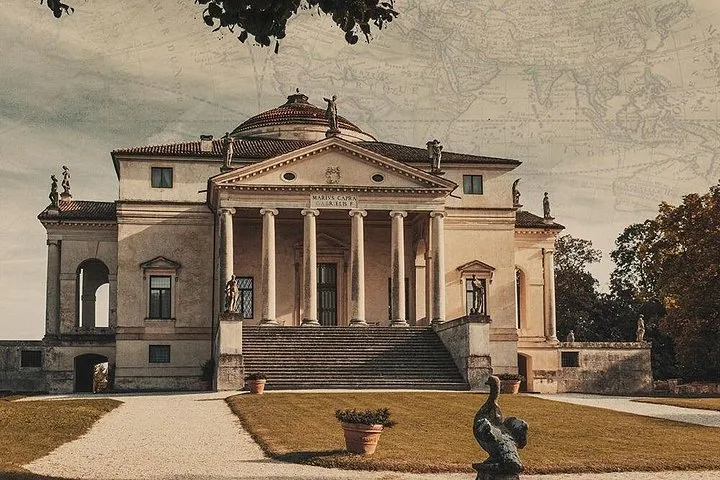 from $111.59
Full day
Palladian Classic - Vicenza 1st Experience
A day in Palladio's Vicenza: Palazzo Valmarana Braga, the Teatro Olimpico show and an e-bike to Villa La Rotonda.
Check AvailabilityPrices, ratings and details are the platform's own. dollar figures are the listed prices — the platform bills in your account's currency.
What the Teatro Olimpico is and why it matters
A short orientation before you book: what this building is, who built it and why people cross the country to see it.
Palladio's last work
The Teatro Olimpico was the final design of Andrea Palladio, the architect whose villas and palaces made Vicenza famous. He had studied ancient Roman theatre writing more closely than anyone alive and illustrated the Italian translation of Vitruvius. In 1579 the Accademia Olimpica, the learned academy founded in the city in 1555, obtained the right to build a permanent theatre inside an old fortress that had served as a prison and powder store.
Palladio flattened the semicircle of a Roman theatre into an ellipse to fit the awkward, shallow space. Construction began in 1580. Palladio died that August, six months in, and his son Silla carried the project on before Vincenzo Scamozzi took charge. Scamozzi had already stepped in to finish Palladio's Villa Capra, known as La Rotonda, and he completed both so well that each is counted among Palladio's finest works.
The theatre opened on 3 March 1585 with a production of Sophocles' Oedipus Rex. Since 1994 it has formed part of the UNESCO World Heritage Site covering the city of Vicenza and the Palladian villas. It is one of only three Renaissance theatres still standing anywhere, alongside the Teatro all'antica in Sabbioneta and the wooden Teatro Farnese in Parma. If you are touring Italian opera houses, this is the oldest roofed theatre on the list by two centuries.
The oldest stage set in the world
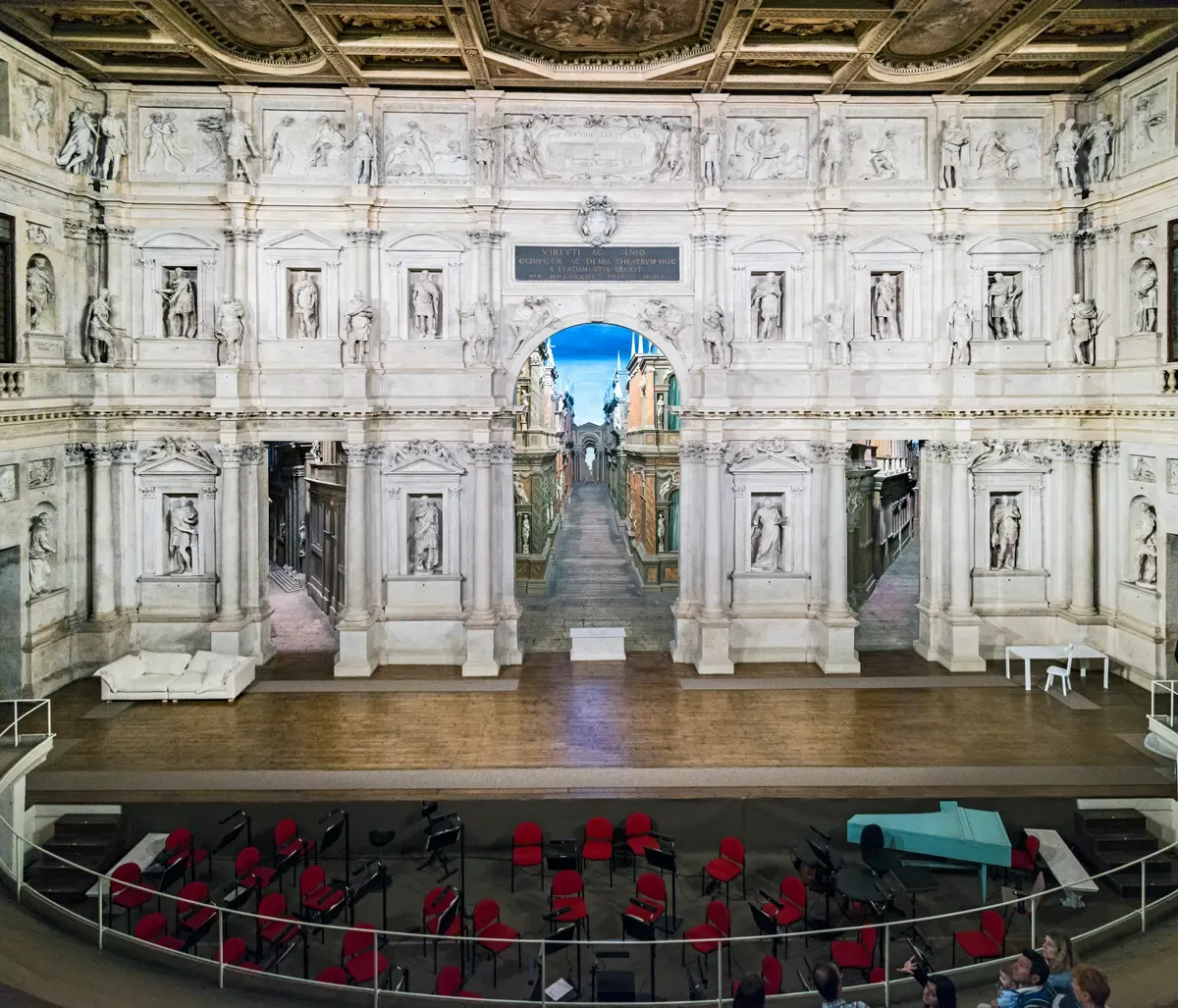
Scamozzi's scenery was built for that first performance and never removed. Seven hallways of wood and stucco recede behind the great stage wall, painted in trompe-l'oeil to look like the streets of Thebes, the setting of the opening play. From the seats, the perspectives appear to run for a hundred metres. In reality the deepest runs only a few metres, thanks to forced perspective and raked floors.
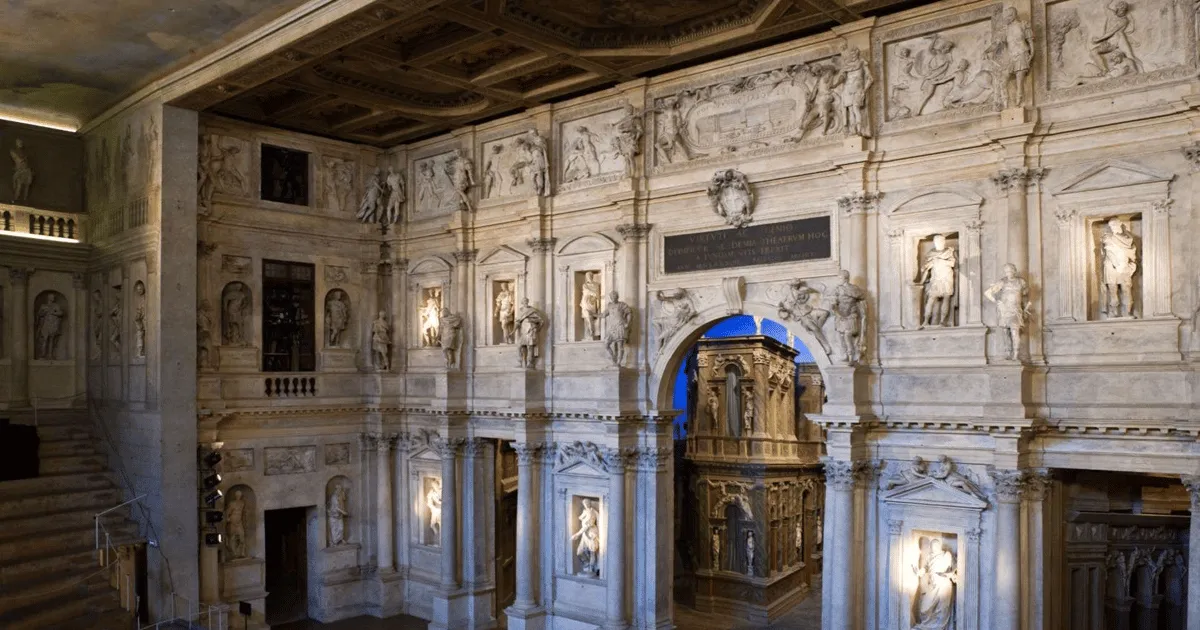
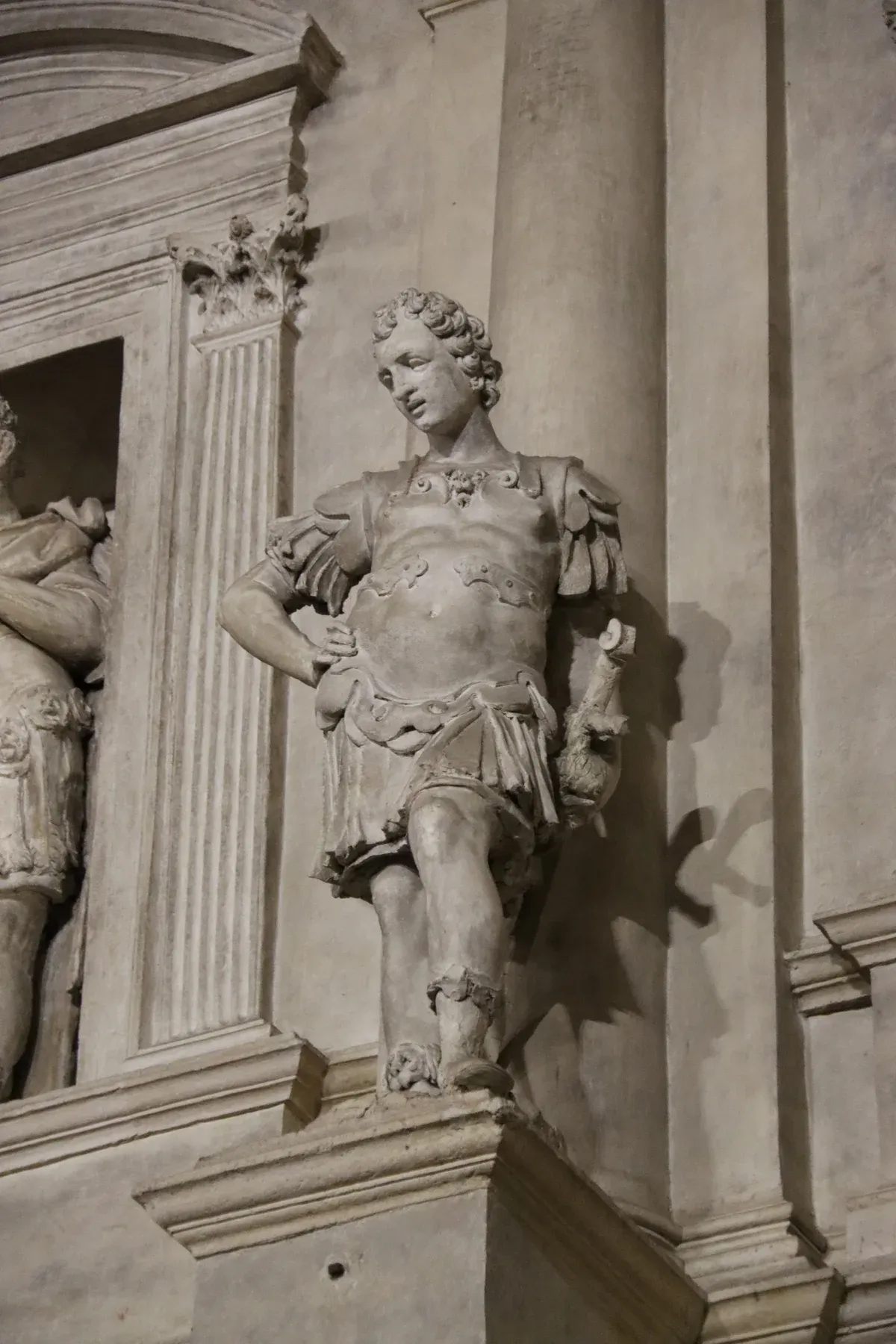
The stage wall itself, the scaenae frons, is wood and stucco imitating marble across two tiers of architecture and statuary. Scamozzi also designed internal lighting for the fake houses, so the streets glowed like a real city at night. Every seat in the house was given at least one perspective view.
The theatre is still used several times a year for concerts and classical drama, so it is a working stage, not a dead museum. For opera in a real season house instead, nearby Verona and Venice are the places to look.
What you see inside, in walking order
The visit is short and linear. Here is the route and where to slow down.
Entrance, courtyard and Odèo
You enter from Piazza Matteotti through the archway Scamozzi cut through the old medieval wall of the fortress. He built the street arch deliberately the same size and shape as the porta regia at the centre of the stage wall, so your eye travels from rough medieval stone to classical marble in a few steps. That transition is the whole point of the design, and most visitors walk through it without noticing.
Beyond the archway lies the courtyard of the old castle, then the two side rooms Scamozzi added, the Odèo and the Antiodèo. Look back at the rusticated entrance arch before you go in: it is a deliberate echo of the stage set waiting on the other side.
The cavea and the stage
The auditorium is a shallow stone ellipse of stepped seating, the cavea, faced with columns and statuary. From the top row you get the best single view of the whole composition, stage wall and scenery together.
Then walk to the barrier in front of the stage. Through the central porta regia and the side openings you look down the seven perspective streets of Thebes. Stand at the left end of the room and then the right: different streets come into focus from each side, which is how Scamozzi gave every seat its own view. The illusion collapses when you see the streets edge-on from the side, so enjoy it front-on first.
Give the perspective street views most of your time. It is the only place in the world where a Renaissance stage set survives in its original theatre, and photographs never quite convey the depth.
Hours, tickets and the best times to go
Opening times change with the season and the theatre closes hard on Mondays. Plan around both.
Opening hours and closures
From 1 September to 30 June the theatre opens 09:00 to 17:00, with the last entry at 16:30. From 1 July to 31 August it opens 10:00 to 18:00, last entry 17:30. It closes every Monday, plus 25 December and 1 January.
Because the theatre still hosts concerts and classical productions, visits can be affected by stage activity. Check the theatre's website before a long journey, the same advice that applies at La Fenice in Venice and La Scala in Milan, where rehearsals close the hall to visitors at short notice.
When it is quiet
Our estimate: the quietest slot is the first hour after opening on a Tuesday or Wednesday, outside Italian school holiday periods. Weekend afternoons draw the biggest crowds, and tour groups cluster mid-morning.
The standard ticket is $13.38 (€12). If you plan more of the city, the Vicenza Card Silver covers 4 of the 11 sites for $18.95 (€17) and the Gold card covers all 11 for $24.50 (€22). There is no formal dress code for a daytime visit, unlike an evening performance, where the usual opera dress code thinking applies in reverse: this is a monument visit, so dress for walking and standing.
Getting to the Teatro Olimpico
The theatre sits at the edge of the old centre of Vicenza, an easy walk from the station.
By train and on foot
Vicenza sits on the main rail line between Venice and Milan, with frequent regional trains from both, plus Verona to the west. Vicenza station is roughly a 15-minute walk from Piazza Matteotti, our estimate over flat city streets.
The address is Piazza Matteotti 11. The theatre is a few minutes' walk from the Basilica Palladiana on Piazza dei Signori, so the two Palladian monuments combine naturally in one circuit. Vicenza itself lies about 60 kilometres west of Venice, which makes it a feasible day trip if you are based there for opera in Venice.
By car and tours from outside
Parking near the historic centre is constrained, and for a short visit the train is simpler. If you are driving between cities, the theatre makes a good stop on the Milan to Venice run.
None of the listed tours includes transport from another city. They all meet in Vicenza: two at Piazza Matteotti and the full-day Palladian Classic at Palazzo Valmarana Braga on Corso Fogazzaro. If you are stitching several cities together, our opera tours in Italy guide shows how a theatre stop like this slots into a longer route.
How much time to give it, and what to pair it with
The theatre itself is compact. The decision is how much of Palladio's Vicenza to add around it.
Three workable routings
On your own, 45 minutes to an hour covers the theatre comfortably. With a guide you get the stories the walls do not tell, such as why the entrance arch copies the stage arch. The table below gives three tested shapes for the day.
Whichever you pick, keep some slack: the theatre closes for stage activity, and the last entry falls 30 minutes before the posted closing time.
| Routing | Time | What you cover |
|---|---|---|
| Theatre only, self-guided | About 1 hour | Archway, courtyard, Odèo, cavea and the perspective streets at your own pace, our estimate |
| Guided walk of the centre | 1.5 to 2 hours | Teatro Olimpico plus the Basilica Palladiana and the main Palladian palaces, with a guide |
| Full day, theatre and villa | Full day | Palazzo Valmarana Braga, the Teatro Olimpico and an e-bike ride out to Villa La Rotonda |
Making it an opera trip
The Teatro Olimpico itself hosts concerts and classical drama a few times a year, not a running opera season. Programmes are announced by the theatre, and details beyond that are not stated here, so check its site for what is on. For a full night of opera nearby, the summer festival in Verona's Roman arena runs each year from June to September, and the indoor seasons of the great houses run from autumn into spring, as explained in our guide to opera festivals in Italy.
If Vicenza is a day trip from Venice, an evening concert back in the city pairs well: the options are compared on our opera in Venice page.
How the theatre came to be
Five centuries from a learned academy to World Heritage listing, in the order it happened.
-
1555
The Accademia Olimpica is founded
A group of Vicentine scholars and nobles founds the Olympic Academy, which will build and still owns the theatre.
-
1579
A fortress becomes a theatre site
The academy obtains rights to the Castello del Territorio, a disused prison and powder store, and asks Palladio for a design.
-
1580
Construction begins and Palladio dies
Work starts on Palladio's design, and the architect dies in August, six months in, with his son Silla taking charge.
-
1582
Extra land is bought for the scenery
The academy acquires the ground behind the stage, allowing the building to be extended for Scamozzi's perspective views.
-
1585
Opening night with Oedipus Rex
The theatre opens on 3 March with Sophocles' Oedipus Rex, and Scamozzi's wooden street scenery, the oldest stage set surviving, is installed for it.
-
1994
UNESCO World Heritage listing
The theatre joins the City of Vicenza and the Palladian Villas of the Veneto on the World Heritage list, where it remains.
Sources: Wikipedia entries for the Teatro Olimpico and Andrea Palladio, cross-checked with the theatre's official visitor information.
Dos and don'ts at the Teatro Olimpico
A short list that saves time and keeps the visit smooth.
Do
- Go at opening time on a weekday for the emptiest room and the clearest view down the perspective streets.
- Buy a Vicenza Card if you plan three or more sites, since the Silver card at $18.95 (€17) beats single tickets quickly.
- Check the theatre's website for closures before travelling, because stage activity can affect visits.
- Walk to the sides of the auditorium to see how a different street view appears from each angle.
- Book the full-day Palladian Classic experience if La Rotonda is on your list, as the e-bike is included.
Don't
- Do not arrive on a Monday, when the theatre is closed all day.
- Do not leave entry until after the last admission time, 30 minutes before closing in both seasons.
- Do not expect an opera performance with your visit: the theatre hosts concerts and drama only a few times a year.
- Do not skip the courtyard and entrance arch, which Scamozzi designed to set up the illusion inside.
- Do not assume a tour includes the theatre ticket: one option leaves entry to you at $13.38 (€12).
Five things most visitors do not know
Details that change how you look at the building.
The list
Read these before you go in and the rooms explain themselves.
- The theatre is built inside a former fortress that had been used as a prison and a powder magazine before the academy took it over in 1579 Wikipedia: Teatro Olimpico.
- The street entrance arch is deliberately the same size and shape as the royal portal at the centre of the stage wall, to ease you from medieval stone into the classical world of the set Wikipedia: Teatro Olimpico.
- The deepest perspective street runs only a few metres, and the illusion of long roads is produced entirely by forced perspective and raked floors Wikipedia: Teatro Olimpico.
- Scamozzi designed lighting that lit the fake houses from within, so the stage streets glowed like a real city at the first performance in 1585 Wikipedia: Teatro Olimpico.
- Only three Renaissance theatres survive anywhere in the world, and the other two, at Sabbioneta and Parma, were both modelled in large part on this one Wikipedia: Teatro Olimpico.
Map: the theatre and what is near it
The Teatro Olimpico sits at the northern edge of Vicenza's old centre, with the Basilica Palladiana between it and the main square, and Villa La Rotonda in the hills south of town.
- 1 Teatro OlimpicoPalladio's indoor Roman theatre of 1585, with the oldest surviving stage set, at Piazza Matteotti 11.
- 2 Basilica PalladianaThe city hall Palladio wrapped in two storeys of arcades, a short walk from the theatre.
- 3 Villa La RotondaPalladio's most famous villa just outside Vicenza, completed by Scamozzi, the e-bike destination on the full-day tour.
Numbers match the pins on the map.
Nearby: what to add to the day
Three places that pair naturally with the theatre.
Basilica Palladiana
Palladio's arcaded city hall on Piazza dei Signori, the building that made his name in Vicenza. The guided monuments tour covers both buildings in one circuit.
About 5 minutes' walk (our estimate) Read the guideVilla La Rotonda
Palladio's villa outside town, finished by Scamozzi after Palladio's death. The Palladian Classic full day reaches it by e-bike with theatre entry included.
South of the centre, e-bike on the full-day tour Read the guideVerona's Roman arena
A first-century Roman amphitheatre that becomes an open-air opera house every summer. See the practical guide to Arena di Verona tickets if you want an opera night to go with the theatre.
Under an hour away by road (our estimate) Read the guideTeatro Olimpico Vicenza: frequently asked questions
How much does it cost to visit the Teatro Olimpico in Vicenza?
A standard ticket costs $13.38 (€12). If you want more of the city, the Vicenza Card Silver covers 4 of the 11 sites for $18.95 (€17) and the Gold covers all 11 for $24.50 (€22). Guided tours that include the theatre start at $38 per person, compared in the ticket table above.
Who designed the Teatro Olimpico?
Andrea Palladio designed it as his final work, drawing on his studies of ancient Roman theatres and Vitruvius. After his death in 1580, Vincenzo Scamozzi completed the building and created the perspective stage scenery. Scamozzi also added the entrance archway and the Odèo side rooms.
What is the programme at the Teatro Olimpico?
The theatre is used several times a year for concerts and classical drama rather than running a continuous opera season. For a full night of staged opera nearby, see the summer festival guide to the Arena di Verona or the indoor houses covered in opera tickets in Italy.
Are there musicals in Vicenza?
Not at the Teatro Olimpico, which is a Renaissance stage reserved for concerts and classical productions. Larger popular productions play elsewhere in the region, and details are not stated here, so check venue listings directly.
When is the theatre open?
Tuesday to Sunday. From 1 September to 30 June it opens 09:00 to 17:00 with last entry at 16:30, and from 1 July to 31 August it opens 10:00 to 18:00 with last entry at 17:30. It closes on Mondays, 25 December and 1 January.
How long should I allow for a visit?
Our estimate is 45 minutes to an hour for the theatre alone, long enough to study the perspective streets from several angles. With a guided walk of the Palladian monuments allow about two hours, and the full-day experience including Villa La Rotonda takes the whole day.
Do I need to book ahead?
Entry is sold per time slot and the last admission falls 30 minutes before closing, so booking the morning is the safe move in our view. The private two-hour Vicenza tour needs a day's notice in practice, and all the listed tours offer free cancellation up to 24 hours before the start except the full-day option, whose terms sit on the listing.
Is the Teatro Olimpico a good stop on an opera trip to northern Italy?
Yes, as a daytime complement rather than an evening out. Vicenza sits between Venice, Verona and Milan, all covered in our guide to opera houses in Italy, and if you need a base the where to stay for opera page compares the practical cities.
Teatro Olimpico on film
Three short films that show Teatro Olimpico and the way in, worth a look before you pick a tour.
Teatro Olimpico: il sogno di Palladio in scena a Vicenza
Filmed by Amicizia in viaggio: Teatro Olimpico as you will see it on the day.
Video: Amicizia in viaggioI luoghi nascosti del Teatro Olimpico di Vicenza
Filmed by VicenzaCultura: Teatro Olimpico as you will see it on the day.
Video: VicenzaCulturaPalladio and the Teatro Olimpico in Vicenza
Filmed by Matteo Monarini: Teatro Olimpico as you will see it on the day.
Video: Matteo MonariniPrices, hours and terms are set by the venue or operator and confirmed at checkout.
We may earn a commission if you book through one of our links, at no extra cost to you. Full affiliate disclosure